Year one of revenue sharing: $1.77 billion, and a market with two tiers
Last Thursday the College Sports Commission put the first year of revenue sharing on the court record. Per the AP, via ESPN, 319 schools opted into the House settlement's revenue-sharing arrangement for 2025-26, 307 of them paid, and the total came to $1.77 billion for 34,915 athletes across 33 conferences and 45 sports. Exactly 68 schools reached the $20.5 million cap or came within 5% of it — the same count as the Power 4 plus Notre Dame, though the filing redacts which 68. The CSC's own release carries the total to the dollar; spread evenly, it is about $5.8 million per paying school and about $50,700 per paid athlete. Neither average describes anyone.
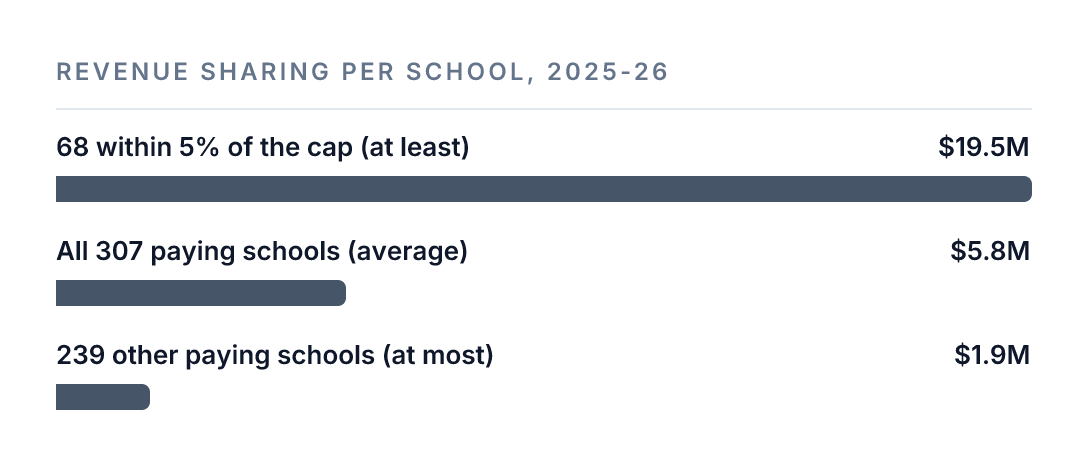
Split the total instead. If the 68 all sat at the cap, they accounted for $1.39 billion of the $1.77 billion — nearly four of every five dollars — and the other 239 paying schools shared roughly $376 million, about $1.6 million apiece. Put the 68 at the bottom of the 5% band and the picture barely moves: at least $1.32 billion to the 68, about three dollars in four, and at most $1.9 million per school to everyone else. Opting in was a yes-or-no question. What a school did after saying yes split the sport into two markets that happen to share a rulebook.
In No. 2 we set the cap math beside our football board. The realized number can now take its place. If those 68 are the Power 4 plus Notre Dame, as is widely assumed, then across every sport they sponsor they paid at most $1.39 billion last year. Our Aug. 31 board for the same 68 programs — football alone — totals $1.70 billion. Setting last season's payments against this season's rosters is not a clean comparison, and the cap rose to $21.58 million this year, but the shape holds: the football board runs past the most those schools could pay every athlete they have. The difference is either value no one pays or money that moves outside the cap, and the retention fund in the Senate bill is built on the second reading.
That bill is parked. ESPN reports that House leaders have no plans to return to Washington this month to take up the Protect College Sports Act, that the bill as written lacks the support to reach a House floor vote, and that it has until the end of the year before the process restarts with a new Congress. Until it moves, the cap is $21.58 million and the $49.08 million ceiling stays hypothetical. Board figures as of Aug. 31, 2026.
One number
68
Schools that reached the $20.5 million cap or came within 5% of it, out of the 307 that paid athletes
The CSC redacts which 68, but 68 is the count of the Power 4 plus Notre Dame. At the cap they paid $1.39 billion of the $1.77 billion; at the bottom of the 5% band, $1.32 billion. Either way the other 239 paying schools averaged under $1.9 million — less than a tenth of what each of the 68 paid. The chart shows the least each of the 68 paid and the most the rest could have. Figures as reported by the College Sports Commission on Oct. 1, 2026.
From the site
Week 5's pick, with the schedule ahead. A signal, never a number.
A back valued near the top of his position on our board, measured against what he did on the field.
239 schools opted in and then averaged under $2 million apiece. Is that a second market, or a formality? Reply to this email — we read everything.
Valuations are The NIL Standard's independent estimates.