The Senate just took up last week's number.
On Tuesday the Senate voted 74-24 to take up the Protect College Sports Act, well clear of the 60 it needed. A final Senate vote is not yet scheduled, and the House, which has failed repeatedly to pass its own version, comes after that. Sen. Maria Cantwell called the margin reason for cautious optimism; Sen. Chris Murphy, leading the opposition, said the bill's core purpose is to protect a system of exploitation. Strip away the procedure and that is the whole argument — whether the cap sits below what the players are worth.
Two provisions in the current text land squarely on last week's issue. Section 114 bars a school, a conference or any "associated entity" — collectives and major boosters, by the bill's own definition — from arranging pay that circumvents the revenue-share cap, and holds a collective's NIL deal to a valid business purpose at a rate a comparable non-athlete would command. Multimedia rights holders, sponsors and apparel companies would have to certify that the school is not the real source of the money. All of it is aimed at the channel we asked about last week: the roughly $220 million between the $1.73 billion we estimate for the 70 football programs we track and the $1.51 billion those schools could pay directly.
The same section then raises the ceiling. A new retention fund lets a school exceed the cap by up to $22.5 million a year to keep athletes who have spent at least one full season on its campus, with up to $5 million more tied to what it spends on women's and Olympic sports, for nine years from enactment. Cap plus fund is $44.08 million per school, and 70 schools at that figure is $3.09 billion of direct-pay capacity against $1.73 billion of football on our board. On paper, last week's gap becomes headroom — shared by every sport a school sponsors, not just this one.
We estimate market value, not payroll, and every ceiling above is one no school is required to fund. But the question on the Senate floor is whether $21.58 million per school sits below what a roster is worth, and the board already answers it: the average program we track carries $24.8 million in football alone. The retention fund is written for players who were on the same roster last season, and those players are 57% of our board — $987.6 million across all 70 programs. Seventy schools at the full $22.5 million is $1.575 billion, a fund larger than every returning player on every program we track, combined. All figures as of Aug. 31.
One number
41%
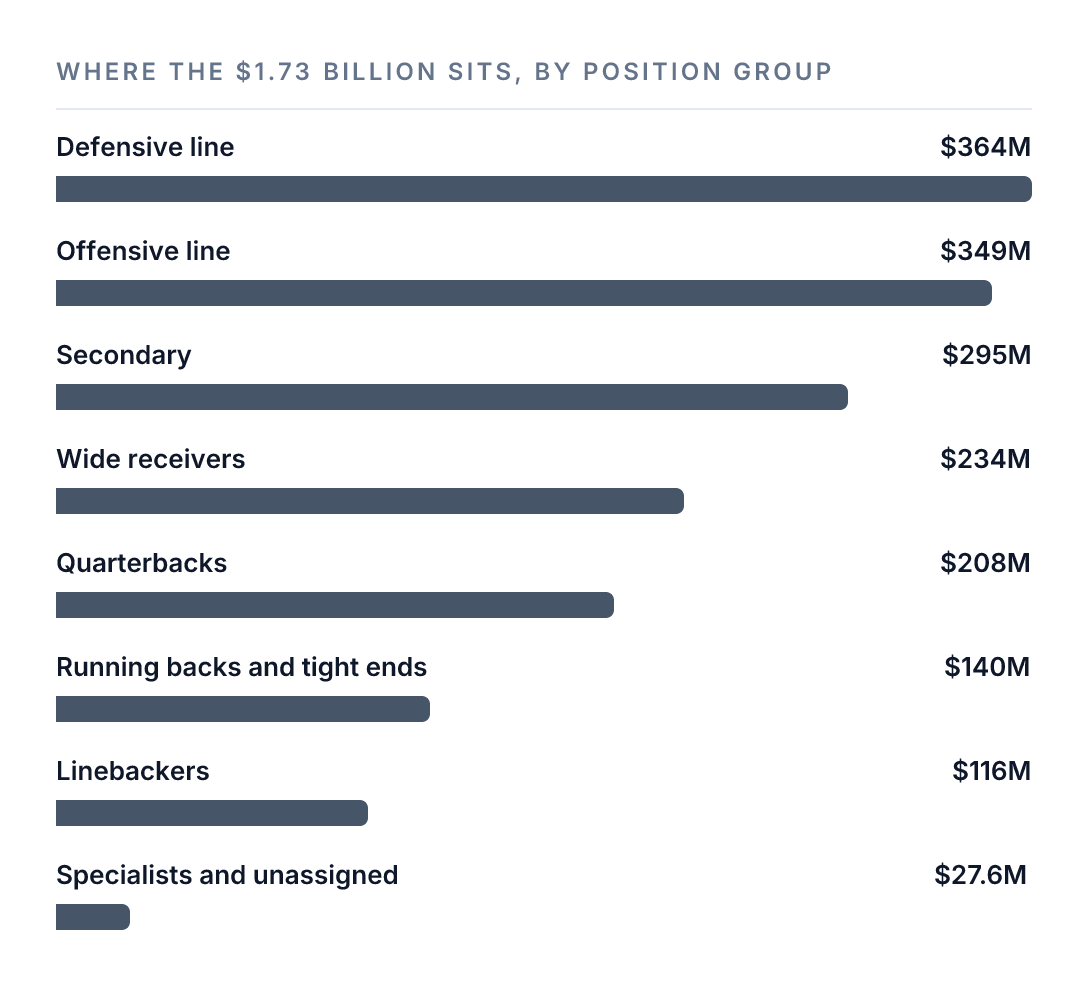
Share of the $1.73 billion on our board that sits on the line of scrimmage, across all 70 programs we track
As promised in No. 1. Offensive linemen are $349.2 million and defensive linemen $363.8 million — $713 million together, more than quarterbacks, running backs, receivers and tight ends combined at $581.6 million. Quarterbacks are the concentration, not the mass: 271 of them carry 12% of the board at about $767,000 each, against a $309,000 board average, and the average quarterback room is about $3 million per school, 14% of the cap by itself. All figures as of Aug. 31.
From the site
The 100 highest-valued players we track, filterable by position.
Previewed by price before kickoff, now settled by the score.
If the ceiling goes to $44 million per school, does the gap close, or does it just move? Reply to this email — we read everything.
Valuations are The NIL Standard's independent estimates.