The House set a date
On Thursday, House Majority Leader Steve Scalise and committee chairs Tim Walberg and Brett Guthrie said in a joint statement they plan to bring the Protect College Sports Act to the House floor the first week of December, the week of the conference title games. Three days earlier, House Republicans who have led the push for new college sports rules doubted it would get a floor vote before the new Congress. The leaders said any changes will stay narrow, to hold together the fragile coalitions behind the bill in both chambers.
The calendar is tight. Any change sends the bill back to the Senate, which passed it 77-22 on Sep 28. Government funding runs out Dec 11, the House's last scheduled day is Dec 17, and if both chambers aren't done when the new Congress is sworn in on Jan 3, the bill starts over in a Congress Democrats control, per CBS Sports. Republicans hold a 218-214 edge, and the leaders' own statement says Democrats oppose the bill outright. Twenty-one House Republicans have objected to its conference membership limits, and House leaders have pulled their own SCORE Act from the floor three times. The day after that deadline, Jan 4, the football transfer window opens.
The bill leaves out collective bargaining on purpose: Ted Cruz has said it was omitted by design to leave room for state approaches. On Nov 10, Tennessee men's basketball players and Athletes.org released a model that would set total player pay in one agreement and, in time, swap NIL deals used in recruiting for a salary structure with spending caps and floors for schools. It's a proposal, not a signed deal, and Tennessee's football program paused a similar effort for the season. A ceiling set by law would sit over budgets that already differ widely by conference; the number below shows how widely. All figures as of Nov 20, 2026.
One number
58%
Share of estimated football roster spend held by the SEC and Big Ten, half of the 68 Power 4 plus Notre Dame programs
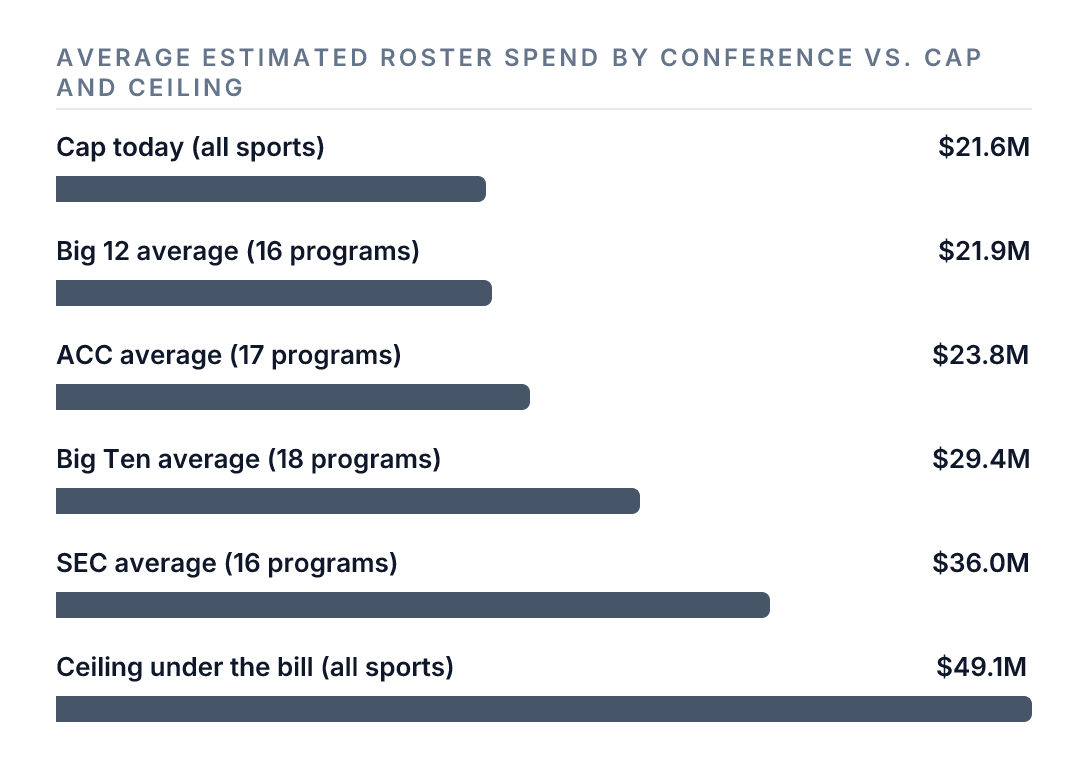
Per program, the SEC averages $36.0 million in estimated roster spend, the Big Ten $29.4 million, the ACC $23.8 million and the Big 12 $21.9 million. All four sit between today's $21.58 million cap and the bill's $49.08 million ceiling, which adds a $22.5 million retention fund and $5 million tied to women's and Olympic sports. The cap and ceiling cover direct pay across all sports; our figure estimates football roster spend, outside endorsements excluded. Spend estimates as of Oct 29, 2026.
From the site
What the bill would do, from the $49.08 million pay ceiling to transfer limits and conference membership, and the Jan 3 deadline it has to beat.
Reported starter prices at all 13 positions in the 2026 market, next to our own starter valuations.
A ceiling set by law, or a ceiling and a floor set by bargaining: which would you rather your program live under? Reply to this email — we read everything.
Valuations are The NIL Standard's independent estimates.