Now there is a reported number for every program we value.
Last Wednesday The Athletic published an estimated roster budget for every Power 4 program and Notre Dame — a range for each of 68 schools, assembled from more than 70 sources, with every school given the chance to weigh in. The ranges run from about $8 million to about $55 million. At least 20 programs are believed to be above $30 million, and the SEC holds 11 of the top 20.
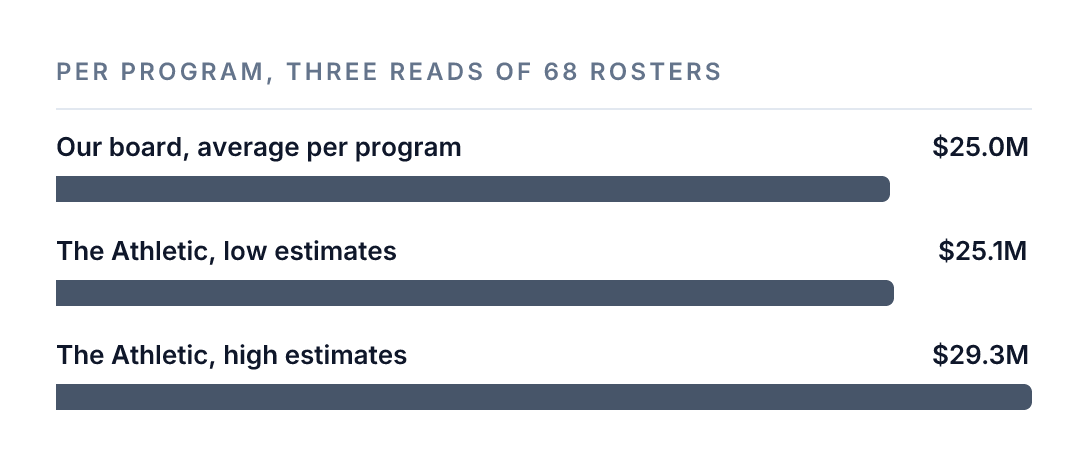
It is the question this newsletter opened with in No. 1: do our prices match the people writing the checks? Until last week there was no reported figure for every program to check against. Read the comparison carefully, though. Their number is what a school had at its disposal to assemble the roster — revenue share, boosters, everything the program controls, setting aside endorsement income it does not. Ours is an independent estimate of what the players on that roster are worth on the NIL market. Different objects, same 68 programs; No. 2's $1.73 billion covered all 70 we track, and Boise State and Oregon State come out here because The Athletic did not estimate them. Add up their 68 ranges and you get a floor of $1.71 billion, a ceiling of $1.99 billion and a midpoint of $1.85 billion. Add up our board for the same 68 and you get $1.70 billion — within half a percent of the floor, 8% under the midpoint. Two methods that never touched each other, sourced spend and modeled market value, put the whole board in the same neighborhood.
The agreement is on the total, not on where it sits. Take their 20 biggest budgets as a group: their ranges sum to $768 million to $867 million, and our board says $679 million, $89.5 million below the bottom of that range. Take the other 48 and we are at $1.02 billion against their $942 million to $1.125 billion, within 1% of the midpoint. Program by program, we sit below their range 33 times, inside it 24 times and above it 11. Read literally, the reporting sees more money concentrated at the top than our model does. Some of that is definitional: a $50 million budget includes what it cost to keep a player from leaving, and a retention premium is a cost, not a market value. Some of it is signal. Values do not move on this in-season; the revaluation before the winter portal is where external evidence like this gets weighed, and it is the best piece of it we have had. All figures as of Aug. 31.
The Senate, meanwhile, advanced the Protect College Sports Act 77-22 last Thursday, and cloture has now been filed on the bill itself and the Cruz–Cantwell substitute, which puts final passage within reach this week. Whatever the tally, the House is out until after the midterms, so nothing in the bill touches this season. The Sept. 17 text keeps the $21.58 million cap and the $22.5 million retention fund — the $44 million ceiling we asked about last week — but a program that misses graduation-rate and academic-progress benchmarks now loses the fund entirely, and the realignment probation dropped from five years to three, expiring six years after enactment.
One number
$1.70B
Our board for the 68 programs The Athletic just priced, against the sum of their ranges: $1.71 billion to $1.99 billion
Within half a percent of the sum of their low estimates and 8% under the midpoint of their ranges. Their figure is what a program had to spend; ours is what the roster is worth. The gap lives at the top: for their 20 biggest budgets we sit $89.5 million below the bottom of their ranges, while for the other 48 we land within 1% of the midpoint. Per program, that is $25.0 million on our board against a $27.2 million midpoint on theirs. All figures as of Aug. 31.
From the site
All 70 team totals, with a free team-level export — rerun this comparison yourself.
Oregon has won the last four meetings. Both rosters priced before Saturday's kickoff.
We land at the floor of their ranges. Is the $150 million between that floor and the middle a premium programs pay to close deals, or money our model doesn't see? Reply to this email — we read everything.
Valuations are The NIL Standard's independent estimates.