The system is working. It's just small.
The College Sports Commission reported Wednesday that its clearinghouse is running better than it has at any point since launch. NIL Go cleared $227.25 million in third-party deals between July 1 and August 31, its largest two-month total on record. It is now deciding more than 200 deals a day, up from 94 a day across its first year, with 68% resolved within a week of receiving complete information. The agency has 29 full-time employees, 12 of them devoted to NIL Go.
"More than half a billion dollars in deals have cleared this system," CEO Bryan Seeley said. He's right, and this is not a story about a broken clearinghouse. It's a story about scale. Since June 2025, NIL Go has cleared 46,478 deals worth $582.49 million — every third-party deal above $600, across all of Division I, in every sport, over fourteen months. Of the $227 million cleared in July and August, $188.6 million came from associated entities: collectives, boosters and rightsholders already inside the schools' own orbit.
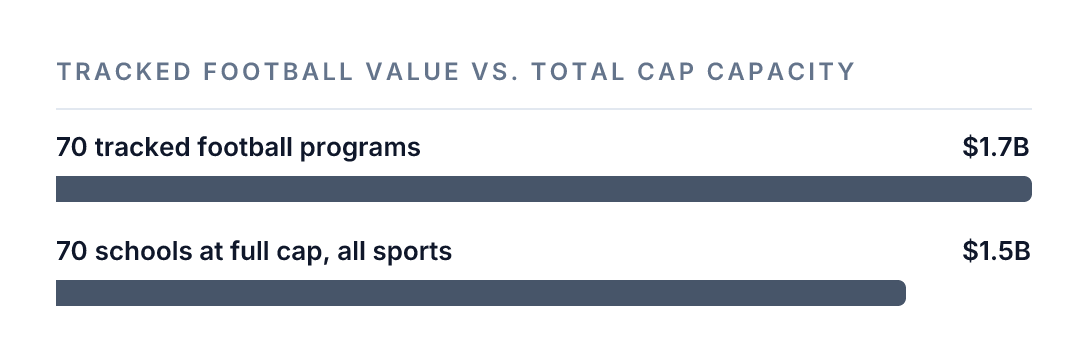
On August 31, the date the commission's new figures run through, we valued the 70 football programs we track at $1.73 billion. One sport. Seventy programs. One day.
We estimate market value, not payroll: what a program is worth, not what any school has paid or reported. The distance between our number and the cap is not evidence that anyone broke a rule. It's the shape of the problem. Direct payment was built to be the main channel, and the top tier of one sport has already outgrown the whole channel — before baseball, before volleyball, before anyone else is funded.
One number
$1.51B
What all 70 tracked programs could pay athletes directly, combined, at the full cap
The revenue-sharing cap rose to $21.58 million per school after an NCAA audit of power conference revenues, and it covers every athlete in every sport a school sponsors. Seventy schools at that cap is $1.51 billion — a generous ceiling, since not every school funds to it. The football programs alone are worth $1.73 billion, about $220 million more. All figures as of Aug. 31.
From the site
Every tracked program's combined estimated market value, ranked. Top 25 up front.
What our estimates measure, what they don't, and why they aren't reported salaries.
Where do you think that $220 million actually comes from? Reply to this email — we read everything. The position-group breakdown promised last week runs in No. 3.
Valuations are The NIL Standard's independent estimates.